
CLINICAL VOICE+ SUITE—AI VOICE RESTORATIVE CHARTING
Voice-Captured Restorative Charting. Standardized Across Every Location. Built into Denticon.
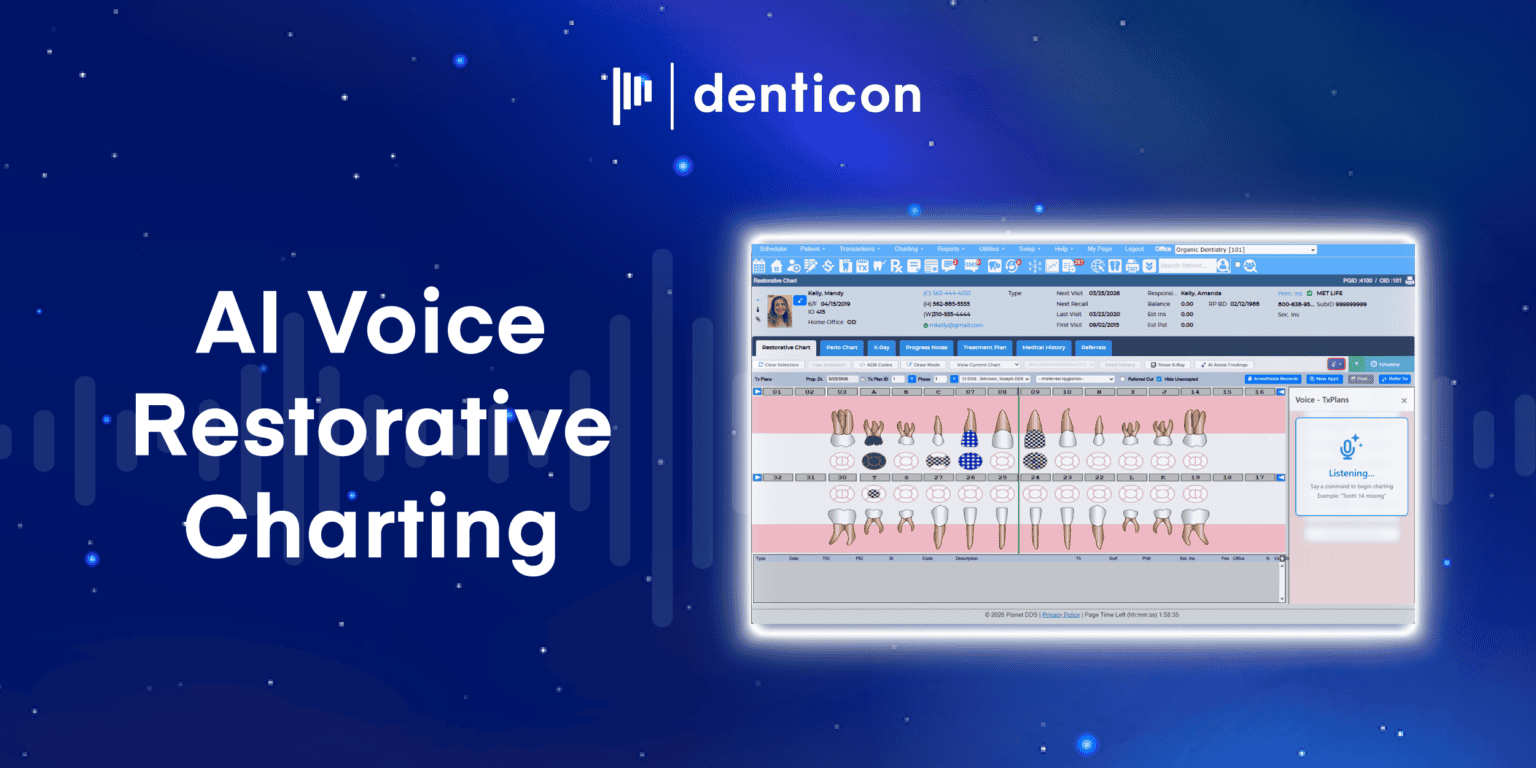
AI Voice Restorative Charting gives multi-location dental organizations a consistent, governable model for restorative documentation.
From AI-assisted to AI-operated. Your path forward.
AI adoption isn’t a switch you flip. It’s a maturity journey—and DentalOS® is designed to meet you wherever you are and carry you forward.
Level 1: Assisted AI
AI supports users but requires human control AI radiograph analysis, charting support, eligibility checks Reduced variability; improved accuracy
Level 2: Advisory AI
AI recommends next actions Treatment suggestions, scheduling insights, claim optimization prompts Faster decisions; fewer manual reviews
Level 3: Agentic AI
AI acts within governed workflows Automated RCM follow-up, scheduling automation, data-driven alerts Significant workload reduction; operational lift
Level 4: Fully Integrated AI Platform
AI connected across the OS powering workflows end-to-end DentalOS-level intelligence across RCM, imaging, analytics, engagement Predictive performance; enterprise-wide consistency

The Problem at Scale
Restorative charting involves workarounds that may feel small in one office. Across 10, 50, or 100+ locations, those inefficiencies really add up. Two-person restorative charting is a perfectly reasonable workflow—until you're managing dozens of locations, each with their own providers, schedules, and habits. At that point, consistency isn't something you can train your way to. You need a documentation model that works the same way regardless of who is in the room. As part of the Clinical Voice+ Suite, AI Voice Restorative Charting extends that voice-captured documentation model from periodontal into restorative workflows.
Common Challenge. Why It Matters. How We Help.
COMMON CHALLENGE | WHY IT MATTERS | HOW WE HELP |
|---|---|---|
Providers click and type during exams or document findings afterward | Disrupts exam flow and leads to less consistent clinical documentation | Hands-free, real-time capture of restorative findings inside Denticon |
Assistants or hygienists are often used to transcribe provider findings | Creates added dependency on staffing availability | Reduces reliance on a second person in the room and reduces rework later |
Claim-supporting documentation varies because findings are entered manually | Greater risk of claim denials and clinical record inconsistencies | Supports clearer, more standardized restorative charting |
Disconnected add-on tools break up the charting workflow | A less unified exam process and less visibility in reporting | Keeps charting in Denticon within the system of record |
Charting methods vary across offices and clinical teams | Harder to repeat a consistent process across the organization | Standardizes restorative documentation across locations |
Your Clinical Teams Will Feel It Too
The clinicians doing this work today are skilled at managing the current workflow. This gives them a better one—charting by voice, hands-free, and in the operatory, without stopping the exam. What they experience as less friction, you see as more consistency across the portfolio. What this enables for growing DSOs and dental groups:
- More consistent restorative documentation across providers and locations
- Cleaner claim-supporting documentation that helps protect revenue
- Less reliance on staffing-dependent workflows that can affect productivity
- Better reporting visibility across the organization
- A more repeatable charting process that supports efficient growth and healthier margins
What AI Voice Restorative Charting Delivers
Voice-captured restorative findings. Ready to approve. Restorative documentation is detailed work—tooth numbers, surfaces, conditions, material types, and treatment recommendations. When it gets deferred to after the appointment, accuracy erodes and re-entry introduces risk.
Tooth conditions and existing restorations captured by voice
Findings mapped to the correct tooth and surface automatically
Treatment plan items documented during the exam
Structured draft—editable before it posts to the chart
Reduces re-entry errors from deferred documentation
No separate system or login—native to Denticon
Who It's For
DSOs and growing dental groups running Denticon
Clinical and operations leaders responsible for documentation consistency at scale
Organizations focused on cleaner claims, stronger reporting, and more repeatable workflows across locations
How It Works
Capture Restorative Findings Hands-Free by Voice During the Exam
Document details in real time without stopping to click through the workflow.
Confirm or Edit Findings with Natural Voice Commands
Make updates in the moment without shifting into a manual charting process.
Chart Directly Inside Denticon
Keep documentation in the system of record instead of a separate tool or side process.
Create a Clearer Record for Claims and Reporting
Support more consistent documentation that is easier to use across claim submission and reporting workflows.

Part of the Clinical Voice+ Suite
AI Voice Perio introduced voice-enabled clinical documentation in Denticon. AI Voice Restorative Charting extends that same approach into restorative workflows, helping organizations bring more consistency to another high-frequency part of the exam experience. AI Voice Progress Notes rounds out the suite by extending the same model into the full narrative note.
AI Voice Restorative Charting. Fully Integrated into Denticon.
Using Denticon and being fully integrated into the system makes it a lot simpler for us. It eliminates the failure points, training, and frustration our staff runs into.

Frequently asked questions
AI Voice Restorative Charting lets providers speak tooth conditions, existing restorations, and treatment plan items during the exam. The AI maps each finding to the correct tooth and surface and structures a draft entry in Denticon for the provider to review and approve before it posts to the chart.
AI Voice Perio and AI Voice Restorative Charting share the same voice engine but apply it to different parts of the exam—perio measurements versus restorative findings, conditions, and treatment plan items. Both are part of the Clinical Voice+ Suite and write directly into Denticon.
Yes. AI Voice Restorative Charting generates a structured, editable draft. Providers review and approve it before anything commits to the chart—the AI structures the input, but the provider retains full control over the final record.
Yes. Because findings are captured by voice directly from the provider, AI Voice Restorative Charting reduces reliance on a second person in the room to transcribe findings, along with the rework that often follows manual entry.
No. It's built natively into Denticon—the same system of record your team already uses for scheduling, billing, and charting. There is no separate application, additional login, or third-party vendor involved.
Yes. Standardized, voice-captured restorative documentation reduces the variability that leads to claim denials and clinical record inconsistencies, and supports clearer, more repeatable documentation across every location.